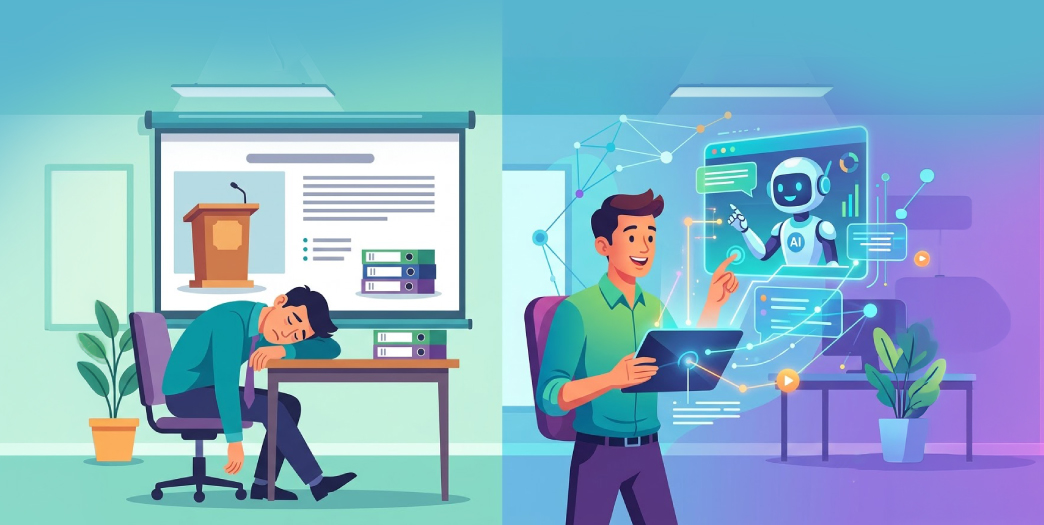

AI role-play for onboarding adds a practice and evaluation layer to traditional employee onboarding. It allows new hires to rehearse role-specific conversations and decisions, receive feedback against defined competencies, and repeat scenarios using company-approved knowledge before they handle those situations independently.
The enterprise value isn’t another way to deliver onboarding content. It is the ability to create repeatable, measurable practice at scale.
A useful onboarding architecture therefore looks less like: Content → Completion → Assessment
and more like: Knowledge → Practice → Feedback → Re-practice → Performance Evidence → Coaching
This gives L&D a closer view of applied capability and gives managers more useful evidence for coaching.
The onboarding gap is not content. It’s application.
Most enterprise onboarding programs already have substantial content.
There are LMS courses, SOPs, product documentation, process guides, videos, job aids, certifications, manager check-ins, and knowledge assessments.
Adding another content format rarely addresses the next stage of the problem.
The harder challenge is applying that knowledge when the situation isn’t perfectly predictable.
Traditional assessments are useful for measuring recall. They are less effective at revealing how someone responds when a conversation changes direction, requirements conflict, or a decision requires judgment.
AI role-play introduces a controlled environment for demonstrating that application.
For enterprise L&D, this creates a more useful evidence chain:
| Traditional onboarding evidence | AI role-play evidence |
|---|---|
| Course completion | Scenario performance |
| Knowledge-test score | Applied knowledge |
| Content consumption | Behavioral response |
| Self-assessment | Observed performance |
| Manager observation | Repeatable practice data |
| Completion status | Competency-level evidence |
The goal is to add performance evidence without discarding existing onboarding measures.
What makes AI role-play different from an AI chatbot?
Calling something “AI role-play” doesn’t automatically make it a training solution.
For enterprise use, the system needs to manage more than conversation.
A meaningful AI role-play experience has at least six layers.
1. Knowledge
The system needs access to the information the learner is expected to use.
For enterprise onboarding, this can include:
- SOPs
- Product documentation
- Policies
- Process guides
- Approved messaging
- Role expectations
2. Scenario
The scenario establishes the business situation, learner objective, constraints, and expected competencies.
3. Persona
The AI character represents the other participant in the interaction, such as a customer, manager, colleague, patient, or stakeholder.
4. Scenario progression
The interaction needs to respond dynamically to the learner’s input.
A learner shouldn’t be able to memorize one ideal answer and receive the same conversation every time. The AI needs to adapt the scenario based on the learner’s choices and responses.
5. Evaluation
The system needs to assess performance against predefined criteria rather than simply generate a conversational summary.
6. Feedback and re-practice
The learner needs actionable feedback and an opportunity to apply it in another attempt.
This creates a closed practice loop: Practice → Evaluate → Feedback → Re-practice
How PersonaTrain turns company knowledge into role-specific practice
Enterprise AI role-play becomes significantly more useful when the underlying AI can work with the organization’s own knowledge and learning requirements.
PersonaTrain uses a multi-agent architecture to separate different responsibilities within the role-play experience. Its architecture includes the Orchestrator, Knowledge Retrieval Agent, Character Agent, Scenario Progression Agent, Guardrail Agent, and Real-Time Evaluation Agent.
The Knowledge Retrieval Agent grounds scenarios in approved organizational content, while the Character and Scenario Progression Agents manage the interaction. Guardrails control AI behavior, and the Real-Time Evaluation Agent assesses performance against defined criteria.
The value of this architecture is functional separation: company knowledge, interaction logic, AI behavior, and evaluation can be controlled independently within the same practice experience.
For L&D, the value isn’t simply the number of agents. It is the separation of functions required to make enterprise AI role-play useful, measurable, and controllable.
Where AI role-play fits in the onboarding architecture
AI role-play shouldn’t be inserted into every part of onboarding.
Its strongest application is where knowledge must be translated into communication, judgment, decision-making, or observable behavior.
| Onboarding requirement | Primary learning approach | Role of AI role-play |
|---|---|---|
| Company information | Digital learning, resources | Limited |
| Product knowledge | Courses, documentation, practice | Moderate |
| Process knowledge | Guided learning, job aids | Moderate |
| Customer conversations | Simulation | High |
| Policy application | Scenario practice | High |
| Difficult conversations | Role-play | High |
| Decision-making | Simulation + coaching | High |
| Administrative onboarding | Workflow/tools | Low |
| Manager conversations | Practice + human coaching | High |
A practical framework for designing AI onboarding scenarios
Build each enterprise scenario around six components:
Context
Define the business situation the employee is entering.
Objective
Specify the outcome the learner needs to achieve.
Persona
Define the person or stakeholder the learner is interacting with.
Constraints
Identify the policies, information, process requirements, and boundaries that apply.
Competencies
Define the behaviors the learner needs to demonstrate.
Evaluation criteria
Specify the evidence that indicates effective performance.
For example, a policy-exception scenario could be structured as follows:
**Context: ** Customer requests an exception to a current policy. ** Objective: ** Resolve the issue without violating policy. ** Persona: ** Frustrated long-term customer. ** Constraints: ** Current return policy and escalation rules. ** Competencies: ** Policy application, empathy, communication, judgment. ** Evaluation: ** Accuracy, clarity, de-escalation, appropriate escalation.
Defining the evaluation criteria upfront also makes the scenario easier to test, compare, and refine.
This approach also makes scenario libraries easier to manage. L&D can organize scenarios by role, competency, proficiency level, business risk, and onboarding stage rather than maintaining a collection of disconnected conversations.
From role-play to readiness: what should L&D measure?
AI role-play becomes more useful when performance data connects to the organization’s capability model.
Rather than treating every simulation as a pass/fail activity, L&D can use the resulting data to identify:
- Demonstrated competencies
- Inconsistent behaviors
- Recurring performance gaps
- Improvement across attempts
- Learners requiring additional practice
- Areas requiring manager intervention
- Competencies showing consistent weakness across a cohort
This creates a bridge between onboarding and talent development.
The resulting evidence can contribute to a broader readiness picture.
That evidence should still be interpreted within context. AI role-play should not become the sole basis for declaring someone ready for a role. Manager observation, assessments, actual job performance, and other evidence remain important.
How AI role-play should work with manager coaching
The strongest enterprise model isn’t AI versus managers.
It is AI for scalable practice and managers for higher-value coaching.
A manager doesn’t need to spend 30 minutes conducting the same introductory practice conversation with every new hire.
The learner can complete repeated AI practice first, allowing the manager to focus on:
- Recurring performance gaps
- Judgment calls
- Complex situations
- Behavioral patterns
- Role-specific coaching
- Readiness discussions
This changes the manager’s role from practice facilitator to performance coach.
For L&D, the operating model becomes:
AI practice → performance evidence → manager coaching → targeted re-practice
That model makes better use of manager time while keeping human judgment within the onboarding process.
What should enterprise teams evaluate before choosing an AI role-play platform?
For enterprise adoption, evaluate the platform across five areas.
Knowledge control
The platform should support grounding scenarios in approved company content.
Evaluate:
- Approved knowledge sources
- Content access controls
- Source management
- Policy updates
- Content refresh processes
Scenario control
L&D should be able to define the situation, learner objective, persona, constraints, competencies, and proficiency level.
Scenario flexibility is particularly important when one onboarding program serves multiple roles or regions.
AI behavior and guardrails
Enterprise teams need visibility into how the AI behaves when information is missing, conflicting, or outside the scenario boundaries.
Evaluate controls for:
- Unsupported information
- Conflicting content
- Policy boundaries
- Scenario boundaries
- Escalation
- AI response controls
Evaluation
The platform should support organization-specific performance criteria.
Look for the ability to evaluate behaviors and competencies rather than simply scoring conversational quality.
Enterprise workflow
AI role-play needs to fit the existing learning ecosystem.
Relevant considerations include:
- LMS integration
- Identity and access
- Reporting
- Administration
- Data governance
- Scalability
- Content management
The evaluation criteria should reflect the organization’s learning and technology environment, not just the quality of the AI conversation.
How to introduce AI role-play without rebuilding onboarding
Start with the existing onboarding program and add practice where it has the most value.
Step 1: Select one high-value role
Choose a role where new hires regularly encounter conversations or decisions that are difficult to practice at scale.
Step 2: Identify three to five critical interactions
Prioritize situations with meaningful customer, compliance, productivity, or business impact.
Step 3: Map them to competencies
Map each interaction to the competencies it is intended to develop or assess..
Step 4: Connect approved knowledge sources
Connect each scenario to the approved sources that govern the interaction.
Step 5: Build and test scenarios
Have experienced SMEs and managers review the scenario logic, expected behaviors, and evaluation criteria.
Step 6: Pilot with a small cohort
Measure both learner experience and performance improvement.
Step 7: Connect results to coaching
Use recurring performance gaps to inform manager coaching and additional learning.
Step 8: Expand the scenario library
Once the model works for one role, extend it to other high-value onboarding situations.
This gives L&D a controlled way to evaluate whether AI role-play improves readiness before making it part of a broader onboarding strategy.
Practicing Beats Presenting
Onboarding shouldn’t stop at teaching new hires what to know. It should help them practice what they’ll need to do.
AI role-play adds that practice layer through realistic scenarios, competency-based feedback, and repeated practice.
PersonaTrain combines company knowledge, AI personas, scenario progression, guardrails, and real-time evaluation to make that practice scalable.
See how PersonaTrain brings AI role-play into enterprise onboarding.
Frequently Asked Questions About AI Role-Play for Onboarding
What is AI role-play for onboarding?
AI role-play for onboarding uses conversational AI to simulate job-specific workplace interactions. New hires respond to AI personas, receive feedback against defined competencies, and repeat scenarios to strengthen their ability to apply knowledge in realistic situations.
How is AI role-play different from an onboarding course?
An onboarding course primarily delivers information or instruction. AI role-play creates an interactive performance environment where learners must respond, adapt, make decisions, and demonstrate behaviors. Both can work together within the same onboarding program.
Can AI role-play be grounded in company SOPs and policies?
Yes. Enterprise AI role-play platforms can use approved organizational content to ground scenarios and responses. This is particularly important for roles involving products, policies, compliance requirements, or customer-facing processes.
How can AI role-play measure new hire readiness?
AI role-play can provide readiness signals through scenario performance and competency evaluation. These should be combined with other evidence, including assessments, manager observations, and job performance.
Does AI role-play replace manager coaching?
No. AI role-play can provide scalable practice and structured performance feedback. Managers remain responsible for contextual coaching, complex judgment, relationship building, and broader readiness decisions.
What should companies look for in an AI onboarding platform?
Look for knowledge grounding, scenario control, AI guardrails, competency-based evaluation, analytics, enterprise integration, and content governance. The platform should support the organization’s learning and performance model rather than operate as a standalone chatbot.
When is AI role-play most useful in onboarding?
It is most useful when employees need to apply knowledge through communication, judgment, decision-making, or behavioral skills. It is less useful for simple information transfer, administrative processes, or basic reference content.