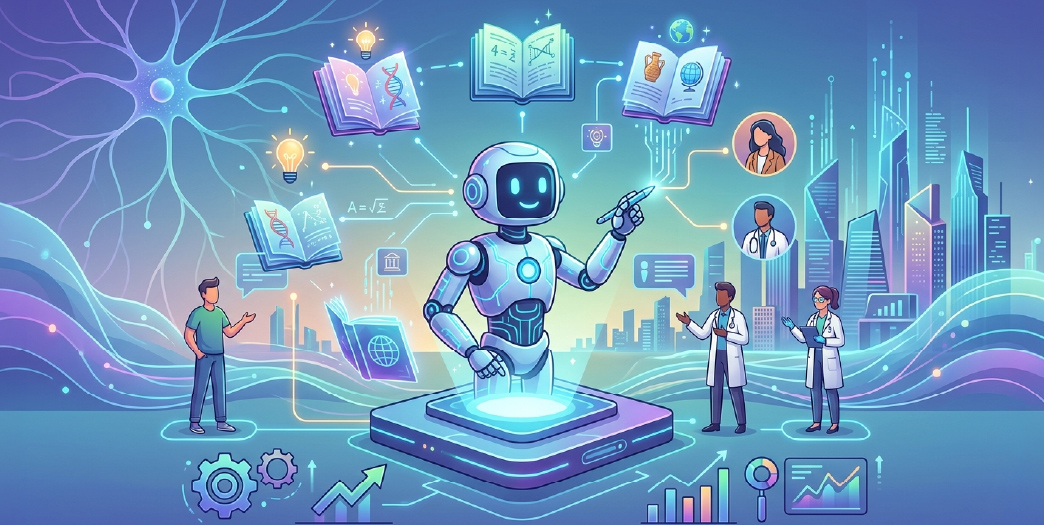

The Problem With Generic AI Chatbots
Every week, another startup launches an “AI training assistant” built on top of a general-purpose language model. They slap a sales persona on ChatGPT and call it innovation. But anyone who has tried using a generic chatbot for sales training, compliance coaching, or customer service practice knows the truth: it falls apart the moment you need specificity.
Generic chatbots hallucinate product features that don’t exist. They quote pricing tiers you retired two quarters ago. They give policy guidance that contradicts your legal team’s latest update. And when a new hire practices against one of these bots, they walk away with confident misinformation, arguably worse than no training at all.
What Knowledge Grounding Actually Means
Knowledge grounding is the principle that every AI response must be sourced from your organization’s actual documents, product specs, sales playbooks, compliance policies, competitive intelligence, and customer FAQs. There is no fallback to the model’s general training data. If the answer isn’t in your knowledge base, the AI says so rather than inventing something plausible.
Under the hood, this requires a sophisticated retrieval-augmented generation (RAG) pipeline. When a trainee asks a question or makes a claim during roleplay, the system performs semantic search across your uploaded documents, retrieves the most relevant passages, and constrains the AI’s response to only that retrieved context. The embedding model understands meaning, not just keywords, so it finds the right content even when the trainee phrases things differently than the source material.
Why Roleplay Is the Killer Use Case
Corporate training has always had a practice problem. Reading a playbook doesn’t prepare you for a hostile negotiation. Watching a video on objection handling doesn’t build muscle memory. The gap between knowing and doing is where most training programs fail.
Roleplay bridges that gap, but traditional roleplay has its own limitations. Managers don’t have time to run practice sessions with every new hire. Peer roleplay lacks realism, your colleague isn’t going to push back the way a skeptical CFO would. And scheduling live practice sessions at scale is a logistics nightmare.
AI-powered roleplay solves the logistics problem, but only if the AI is grounded in reality. When the AI prospect pushes back on your pricing, it should reference actual competitive alternatives from your battlecard. When it raises a compliance concern, it should cite the real regulation your team needs to navigate. This is where knowledge grounding transforms roleplay from a novelty into a legitimate training tool.
The Multi-Modal Advantage
Text-based roleplay is a good start, but real conversations happen across modalities. A sales rep needs to handle a prospect’s tone of voice. A financial advisor needs to read body language cues. A customer service agent needs to manage the pace and flow of a live call.
PersonaTrain delivers training across text, voice, and video channels. Our full-duplex voice mode captures the rhythm of real conversations, including interruptions, filler words, and the pressure of thinking on your feet. Video avatar mode adds face-to-face dynamics with photorealistic AI characters that express emotion and react visually to what the trainee says. Each modality is fully knowledge-grounded, so the AI never goes off-script regardless of the channel.
The Business Impact
The numbers tell a compelling story. Organizations using knowledge-grounded roleplay training see an average 40% reduction in ramp time for new hires. Trainees complete 3x more practice sessions compared to traditional methods because the AI is available 24/7 and never gets tired, frustrated, or inconsistent.
But the real impact goes beyond efficiency metrics. When every practice conversation is grounded in your actual knowledge base, trainees build accurate mental models of your product, your market, and your customer’s world. They internalize the right responses because they’ve practiced against realistic scenarios hundreds of times. Quota attainment improves. Compliance violations decrease. Customer satisfaction scores climb.
The Path Forward
The AI training revolution isn’t about replacing human coaches, it’s about giving every employee access to unlimited, high-quality practice that was previously reserved for the lucky few who had a great manager with spare time. Knowledge grounding is what makes this possible. Without it, you’re just practicing against a chatbot that makes things up. With it, you’re building real competence rooted in your organization’s actual expertise.
Learn more about how our agentic engine works or see how TechFlow cut ramp time by 40%.
The companies that figure this out first will have a compounding advantage. Every new document uploaded makes the training better. Every scenario refined makes the practice more realistic. Every session completed makes the team more capable. That flywheel is what makes knowledge-grounded roleplay not just a better training tool, but a strategic asset.