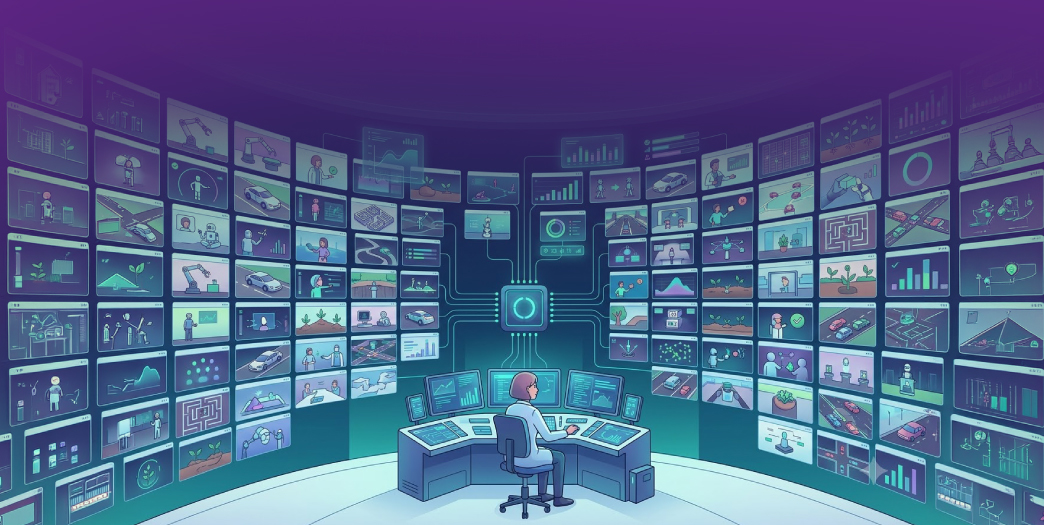

Managing hundreds of AI training simulations requires more than generating scenarios quickly. L&D teams need a system for organizing, governing, evaluating, updating, and retiring simulations as the portfolio grows.
A sales team may build AI role play scenarios for discovery calls and objections. Customer service may create simulations for escalations. Leadership teams may need difficult-conversation practice. Regional teams may adapt scenarios for local requirements.
The answer isn’t to limit AI scenario creation. It’s to build the management structure around it.
Why AI Training Simulations Become Difficult to Manage at Scale
AI training simulations become difficult to manage when scenario volume grows faster than the organization’s ability to organize, review, maintain, and reuse them.
AI has changed the economics of scenario creation. What once required substantial scripting and instructional design effort can now be produced much faster. When AI role play authoring becomes easier, teams can create more scenarios than they can reasonably govern.
Imagine three teams building negotiation practice. One creates a pricing objection scenario. Another creates a version for enterprise buyers. A regional team creates another for its market.
Each scenario may have a legitimate purpose. But without AI scenario management, nobody can easily tell whether the organization has three distinct learning experiences or three versions of the same one.
What Is a Simulation Sprawl?
Simulation sprawl is the uncontrolled growth of AI training simulations without a clear system for organization, ownership, governance, reuse, and retirement.
It usually appears in several ways:
| Problem | Enterprise impact |
|---|---|
| Duplicate scenarios | Teams recreate experiences that already exist |
| Unclear ownership | Nobody is accountable for updates |
| Version confusion | Learners may access outdated experiences |
| Inconsistent evaluation | Similar skills are measured differently |
| Poor discoverability | Authors struggle to find relevant scenarios |
| Outdated content | Simulations no longer reflect current business requirements |
A designer shouldn’t have to discover through trial and error that another team already created the simulation they need. A business SME shouldn’t have to review several versions of essentially the same scenario. And learners shouldn’t be practicing against outdated product, process, or policy information.
What Should AI Training Simulation Governance Include?
AI training simulation governance should define who can create, review, approve, maintain, evaluate, and retire simulations.
Scenario ownership
Every simulation should have an owner responsible for keeping it relevant.
That owner doesn’t need to handle every part of the process. L&D may own the learning objective, a business SME may validate accuracy, and compliance may approve regulated content.
Approval and review
Not every scenario needs the same level of review.
A leadership coaching simulation may require L&D and a subject matter expert. A compliance simulation may require additional functional or compliance approval.
The review path should reflect the risk and business context.
Version management
When a product, policy, process, or message changes, teams need to identify which simulations are affected.
A simple status structure can help:
Current → Under review → Superseded → Retired
This prevents an old simulation from remaining available simply because nobody removed it.
Evaluation standards
Governance should also define how important skills are assessed.
If five simulations teach negotiation, they don’t need to be identical. But they should have consistent principles for evaluating behaviors such as questioning, needs identification, objection handling, and commercial judgment.
That gives L&D comparable performance information across different practice experiences.
How Should Organizations Organize AI Training Simulations?
Organizations should organize AI training simulations around the business context, skills, learner roles, and situations they are designed to address.
A useful taxonomy might include:
| Dimension | Example |
|---|---|
| Business function | Sales |
| Skill | Negotiation |
| Learner role | Enterprise account executive |
| Situation | Pricing objection |
| Difficulty | Advanced |
| Product | Enterprise platform |
| Region | North America |
| Status | Current |
A structured taxonomy makes AI role play scenarios easier to find, compare, reuse, and maintain. It also changes how authors approach AI scenario creation.
Instead of: Need → Create
the workflow becomes: Need → Find → Reuse or adapt → Create when necessary
That small change can reduce duplicate authoring significantly as the program grows.
How Does a Training Scenario Library Support Scenario Management?
A training scenario library gives L&D teams a centralized way to organize, discover, reuse, review, and maintain AI training simulations.
A useful library should give teams visibility into each scenario’s purpose, audience, skill focus, business context, owner, approval status, current version, and review history.
A centralized library also supports AI role play training across functions without forcing every team to build its own disconnected collection.
Sales can maintain its scenarios. Customer service can maintain theirs. Regional teams can create approved variations.
Build an AI Training Simulation Lifecycle
An AI training simulation should move through a defined lifecycle from creation to retirement.
A practical lifecycle is: Create → Review → Approve → Publish → Practice → Analyze → Update → Retire
| Stage | Purpose |
|---|---|
| Create | Define the performance need and scenario |
| Review | Check instructional quality and business accuracy |
| Approve | Complete required stakeholder review |
| Publish | Make the approved simulation available |
| Practice | Give learners realistic opportunities to apply the skill |
| Analyze | Identify performance patterns and gaps |
| Update | Revise the simulation when requirements change |
| Retire | Remove experiences that no longer serve a useful purpose |
A product changes. A policy changes. A process changes. A customer expectation changes. The corresponding simulation may need to change too.
Treating scenario creation as the end of the process is one of the easiest ways for an AI training portfolio to become outdated.
What Should an Enterprise AI Training Platform Support?
An enterprise AI training platform should support the full simulation lifecycle, not just AI role play authoring or scenario generation.
| Capability | Why it matters |
|---|---|
| AI scenario creation | Build new practice experiences efficiently |
| AI role play authoring | Structure realistic conversations without excessive manual setup |
| Search and filtering | Find existing simulations quickly |
| Reuse and adaptation | Reduce duplicate scenario creation |
| Taxonomy | Organize simulations around skills and business needs |
| Ownership | Make accountability visible |
| Approval workflows | Control quality and business accuracy |
| Version management | Separate current and outdated content |
| Evaluation | Measure relevant skills consistently |
| Analytics | Understand learner performance |
| Maintenance | Keep simulations aligned with business changes |
| Retirement | Remove simulations that no longer serve a purpose |
This is an important distinction when evaluating an AI role play platform.
A platform may make it easy to generate hundreds of simulations. That doesn’t automatically make those simulations manageable.
The technology needs to support the operating model around them.
How Can AI Support AI Scenario Management?
AI can support AI scenario management by reducing the repetitive work involved in creating, adapting, analyzing, and maintaining simulations.
For example, teams can use AI to create variations of an existing scenario for different learner groups, adapt practice to different business contexts, summarize performance patterns, and support content refinement.
L&D and business stakeholders still need to determine whether a scenario is instructionally appropriate, factually accurate, and relevant to the learner’s work.
A useful division of responsibility is simple: **AI handles repeatable work. People handle judgment. **
That becomes increasingly important as enterprise AI training expands beyond individual pilots into sales, customer support, leadership, onboarding, compliance, and other functions.
Standardize the Management Layer, Not Every Simulation
Enterprise role play training works better when organizations standardize how simulations are managed without forcing every simulation to be identical.
Standardize:
- Metadata
- Ownership
- Approval rules
- Evaluation principles
- Version status
- Review cycles
- Retirement criteria
Allow flexibility in:
- Learner role
- Business situation
- Persona
- Difficulty
- Regional context
- Product or workflow
- Conversation style
A global sales organization may need very different scenarios from a customer service team. Regional teams may also need local variations.
Good governance doesn’t remove those differences. It makes them manageable.
How PersonaTrain.ai Fits into Enterprise AI Role Play Training
PersonaTrain.ai supports AI role play training by helping teams create context-rich simulations grounded in organizational knowledge, workflows, and business requirements.
That matters because enterprise practice shouldn’t exist in isolation from the work learners actually perform.
Teams can create simulations around real workplace conversations, decisions, and workflows, then use business context to make the practice relevant to the learner’s role.
The broader workflow is:
Define the need → Create → Ground in business context → Review → Practice → Evaluate → Refine → Reuse
This connects AI role play authoring with the larger simulation lifecycle.
The value is a repeatable approach to creating, evaluating, and maintaining practice as AI role play training expands across the organization.
The Goal Isn’t Hundreds of Simulations. It’s a Manageable Practice System.
Once an organization has hundreds of scenarios, the important question isn’t how quickly another one can be generated. It’s whether teams can find the right simulation, trust its content, measure the right skills, keep it current, and retire it when it no longer matters.
That’s the difference between having a large collection of simulations and having a scalable practice system.
If you’re already seeing duplicate scenarios, unclear ownership, outdated content, or difficulty finding the right practice experience, review the management model behind your simulations before creating more.
If you’re evaluating an AI training platform for enterprise- scale practice, PersonaTrain.ai provides a way to explore context-driven AI role play training across business functions and real workplace situations.
FAQs
What are AI training simulations?
AI training simulations are interactive practice experiences in which learners use AI to work through realistic workplace situations. They can simulate conversations, decisions, objections, customer interactions, or other job-specific situations and provide feedback on performance.
How do you manage AI training simulations at scale?
Manage AI training simulations through a centralized operating model covering taxonomy, ownership, approvals, version control, evaluation standards, review cycles, and retirement. This gives L&D teams visibility and control as simulation volume increases.
What is AI training simulation governance?
AI training simulation governance defines the roles, standards, and processes used to create, review, approve, maintain, evaluate, and retire simulations. It ensures responsibility for learning quality, business accuracy, and ongoing relevance is clearly assigned.
How should organizations organize AI role play scenarios?
Organizations should organize AI role play scenarios by business function, skill, learner role, situation, difficulty, product or process, region, and status. This makes simulations easier to find, reuse, adapt, and maintain as the training portfolio grows.
What should an AI role play platform include?
An AI role play platform for enterprise use should support scenario creation, authoring, search, reuse, governance, ownership, version management, evaluation, analytics, maintenance, and retirement. It should also support the business context and workflows relevant to the organization.
How can L&D prevent duplicate AI training simulations?
L&D teams can reduce duplicate AI training simulations by using a centralized, searchable training scenario library and requiring authors to check existing content before creating new scenarios. Strong metadata makes similar experiences easier to identify and adapt.