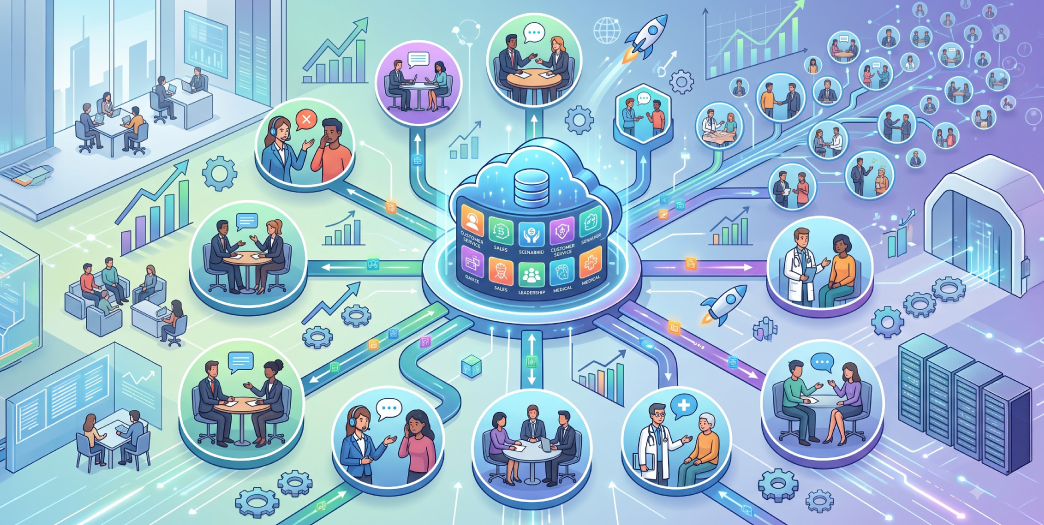

Creating an AI role play scenario is getting easier. Managing hundreds of them is not.
That’s the problem L&D teams can run into when AI role play training moves from a pilot to an enterprise program. One team creates scenarios for sales. Another builds them for customer service. Regional teams add their own versions. Before long, the challenge isn’t creating scenarios. It’s knowing what already exists, which version is approved, and what should be used next.
This is where a centralized scenario library becomes important. It gives L&D teams a structured way to create, organize, review, reuse, and maintain scenarios as the program grows.
The goal isn’t more scenarios. It’s a library the organization can actually trust and use.
Why AI Role Play Training Creates a New Scenario Management Problem
AI changes the economics of scenario creation.
When teams can produce scenarios much faster, the number of practice experiences in an organization can grow quickly. That’s useful, but it also introduces a problem that isn’t discussed enough: who manages all those scenarios once they’re created?
Consider a global sales organization.
The enablement team creates a scenario for handling a pricing objection. A regional team creates another version for its market. A product team creates one for a new offering. A manager asks for a harder version for experienced sellers.
Six months later, there may be several scenarios addressing essentially the same skill.
None of them is necessarily wrong. The problem is that nobody knows which one should be used.
This is scenario sprawl.
Scenario sprawl isn’t simply having a large number of scenarios. It happens when an organization creates scenarios faster than it can organize, govern, maintain, and reuse them.
And that’s where scaling AI role play training becomes an operating challenge rather than an authoring challenge.
What Is a Centralized Scenario Library?
A centralized scenario library is a shared environment where an organization can create, organize, review, manage, reuse, and maintain AI role play scenarios.
The distinction between a library and a repository matters.
A repository primarily stores content. A useful scenario library helps people find the right experience, understand its purpose, reuse it, and know whether it is still current.
For an L&D team, that could mean finding advanced sales scenarios focused on negotiation. For a manager, it could mean locating practice for a difficult performance conversation. For a compliance team, it could mean identifying scenarios affected by a policy change.
Instead of asking, “How do we create another scenario?”, teams can ask, “Do we already have something that meets this need, and if not, what should we create?”
What a Centralized Scenario Library Solves
The value of centralization becomes clearer when you look at what happens without it.
Duplicate Authoring Becomes Easier to Avoid
Before building a new scenario, an instructional designer should be able to see whether something similar already exists.
Suppose a customer service team needs a scenario for handling an angry customer. If a strong scenario already exists, the team might only need to adapt the customer profile, business context, or difficulty level.
Without that visibility, the team may start again from scratch.
This creates unnecessary authoring work and makes the overall library harder to manage.
It Creates a Single Source of Truth
Enterprise training doesn’t stay static.
Products change. Processes change. Policies are updated. Approved messaging gets replaced.
If different teams maintain their own scenario copies, updating all of them becomes difficult. It can also become unclear which version learners should be practicing with.
A centralized library gives L&D teams one place to identify the current version and manage what needs review.
That doesn’t mean every scenario needs the same owner or approval process. It means the organization has visibility into what exists and who is responsible for it.
It Makes Scenarios Easier to Discover
A library with hundreds of scenarios is only useful if people can find the right one.
This is where taxonomy matters.
Instead of organizing scenarios only by department, consider multiple dimensions:
| Dimension | Example |
|---|---|
| Business function | Sales |
| Skill | Negotiation |
| Situation | Price objection |
| Learner role | Enterprise account executive |
| Difficulty | Advanced |
| Product | Enterprise platform |
| Competency | Commercial communication |
Now the scenario has context.
An L&D designer isn’t simply searching through “Sales Scenarios.” They can identify a specific practice experience based on the skill, audience, situation, and level of challenge.
That makes the library easier to use as the number of scenarios grows.
How Should Organizations Organize AI Role Play Scenarios?
There isn’t one perfect taxonomy for every organization.
The structure should reflect how your business thinks about roles, skills, and performance.
But I recommend starting with five questions:
Who is practicing? Define the learner’s role and experience level.
What are they practicing? Identify the skill or competency the scenario is designed to develop.
What situation are they practicing? Connect the scenario to a real business conversation or challenge.
How difficult should it be? Consider the level of ambiguity, resistance, objections, or competing priorities.
What business context does the conversation require? Identify the products, processes, policies, services, or organizational knowledge the AI character needs to reflect.
This structure is more useful than naming scenarios based only on the conversation.
For example:
Sales → Negotiation → Pricing objection → Enterprise AE → Advanced → Product X
Tells an L&D team far more than: Difficult Sales Conversation
Governance Is What Keeps a Scenario Library Useful
This is the part I would pay particular attention to in an enterprise environment.
Creating a scenario is only the beginning.
Someone needs to decide whether it’s instructionally sound. Someone needs to verify the business information. Someone needs to approve it when the subject is regulated or sensitive. And someone needs to know when it should be reviewed again.
A simple ownership model might look like this:
| Responsibility | Typical owner |
|---|---|
| Learning objectives | L&D / Instructional Design |
| Business accuracy | SME / Business owner |
| Policy accuracy | Compliance / Functional owner |
| Scenario approval | L&D + Business owner |
| Ongoing updates | Scenario owner |
| Performance review | L&D / Manager |
| Retirement | Scenario owner + L&D |
A compliance scenario may require more formal review than a general sales practice scenario. A leadership scenario may need a different SME than a product-focused sales simulation.
The important part is that ownership exists.
Without it, even a centralized library can become a collection of scenarios that nobody wants to maintain.
Build a Scenario Lifecycle, Not a One-Time Publishing Process
A strong scenario library needs a defined lifecycle. A scenario shouldn’t simply be created and published. It needs to be reviewed, maintained, and eventually retired when it no longer reflects the business.
Create → Review → Approve → Publish → Practice → Analyze → Update → Retire
| Stage | What happens |
|---|---|
| Create | Define the business problem and learning objective. |
| Review | Check instructional quality, accuracy, and level of challenge. |
| Approve | Complete the required business or compliance review. |
| Publish | Make the approved scenario available to the intended audience. |
| Practice | Let learners use it in a realistic interaction. |
| Analyze | Review learner performance and identify gaps. |
| Update | Revise the scenario when the context or learning need changes. |
| Retire | Remove scenarios that no longer serve a useful purpose. |
AI makes it easier to produce scenarios, but that doesn’t mean every scenario should remain active forever. A scenario that was accurate six months ago may no longer reflect the product, process, policy, or customer conversation learners face today.
Centralized vs. Decentralized Scenario Management
The difference becomes clear when you look at how each model works at scale.
| Decentralized scenario management | Centralized scenario management |
|---|---|
| Scenarios spread across teams | Shared scenario environment |
| Duplicate authoring | Reuse and adaptation |
| Unclear ownership | Defined ownership |
| Multiple versions | Easier version control |
| Difficult discovery | Searchable and structured |
| Different evaluation approaches | Consistent standards |
| Ad hoc reviews | Defined review process |
| Outdated content can remain active | Review and retirement process |
Centralization doesn’t mean every team needs identical scenarios. A global sales team can have different scenarios from customer service, and regional teams can have local variations. What they share is the system for managing those scenarios.
What Should an Enterprise Scenario Library Include?
If I were evaluating an AI role play platform for an enterprise team, I wouldn’t start by asking how many scenarios it can generate.
I’d ask what happens after those scenarios are created.
At a minimum, I’d look for capabilities that support the full scenario lifecycle.
Search and filteringCan L&D teams quickly find scenarios by role, skill, business function, difficulty, or situation?
Scenario reuse and adaptationCan an existing experience be modified for another learner group without rebuilding everything?
Ownership and approvalsCan the organization make responsibility for scenario quality clear?
Version managementCan teams distinguish current scenarios from older versions?
Business contextCan scenarios reflect the organization’s products, processes, policies, and messaging?
Evaluation consistencyCan scenarios assess the skills learners are actually expected to demonstrate?
Scenario maintenanceCan teams review, update, and retire scenarios as requirements change?
How PersonaTrain.ai Fits into a Centralized Scenario Library
This is where AI-assisted scenario creation and scenario management need to work together.
PersonaTrain.ai can help L&D teams create AI role play scenarios around specific learner needs and business situations, while keeping authors involved in reviewing and refining the final experience. The AI can handle much of the repetitive setup, while L&D teams remain responsible for accuracy, relevance, and instructional quality.
The resulting workflow is:
Identify the learning need → Create → Review → Refine → Publish → Reuse → Update
That approach becomes more useful as organizations expand AI role play training across multiple functions.
How to Evaluate an AI Role Play Platform for Scale
The most useful evaluation questions aren’t about scenario volume.
They’re about what happens when the volume increases.
Ask:
- Can we manage scenarios from a central environment?
- Can we find existing scenarios before creating new ones?
- Can we reuse and adapt scenarios for different audiences?
- Can we organize scenarios around skills and business situations?
- Can we maintain organizational context across scenarios?
- Can we control who can create, review, and publish scenarios?
- Can we keep evaluation criteria consistent?
- Can we identify scenarios that need updating?
- Can we retire scenarios that are no longer relevant?
A platform that answers these questions well is supporting more than scenario creation.
It supports the operating model behind AI role play training.
The Goal Isn’t More Scenarios. It’s Better Scenario Management.
Scaling AI role play training isn’t about creating more scenarios. It’s about creating the right scenarios, keeping them relevant, and making them easy to manage as your program grows.
A centralized scenario library gives L&D teams the structure to do that.
With PersonaTrain.ai, teams can create AI role play scenarios faster, organize practice around specific business needs, and keep authors involved in reviewing and refining the final experience.
If you’re ready to scale AI role play training without creating a scenario management problem, book a consultation.
FAQs
How does a scenario library help scale AI role play training?
A scenario library helps organizations reduce duplicate authoring, make scenarios easier to find, maintain consistent standards, and keep content current. This allows L&D teams to expand AI role play training without letting scenarios become scattered across teams or systems.
What is scenario sprawl?
Scenario sprawl occurs when an organization creates many AI role play scenarios without a clear system for organizing, governing, maintaining, and retiring them. It can lead to duplicate scenarios, inconsistent evaluation, outdated content, and difficulty finding the right practice experience.
How should organizations organize AI role play scenarios?
Organizations can organize scenarios by business function, skill, business situation, learner role, difficulty, and business context. Combining these dimensions makes scenarios easier to discover and reuse as the library grows.
What should an enterprise scenario library include?
An enterprise scenario library should support search, filtering, categorization, reuse, ownership, approvals, version management, business context, evaluation criteria, and scenario maintenance. The exact governance model should reflect the organization’s needs.
How can L&D teams keep a scenario library current?
Assign ownership to scenarios and establish review cycles. Update scenarios when products, processes, policies, or learning requirements change. Scenarios that are no longer relevant should be retired rather than left available indefinitely.