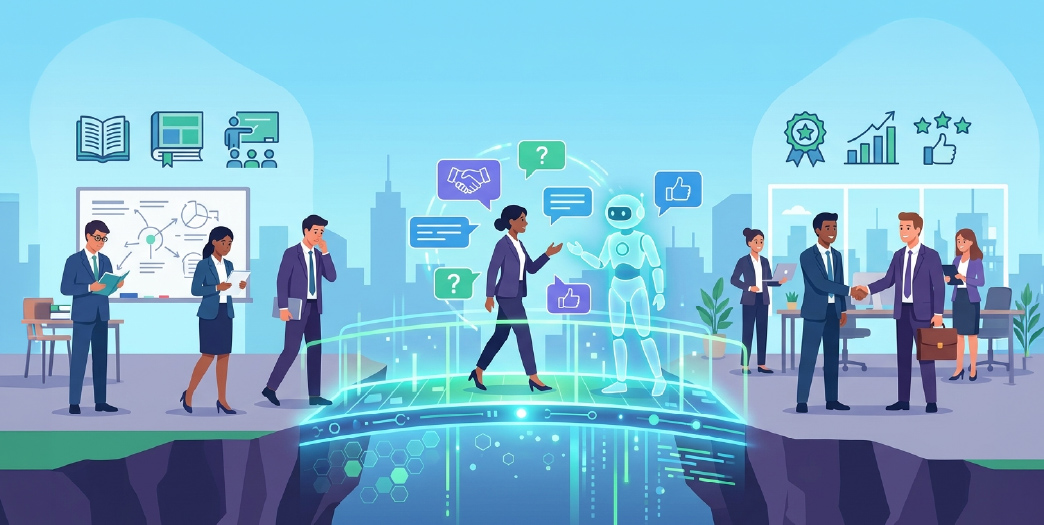

The Training-to-Performance Gap in Corporate Learning
Every L&D leader has been there: teams completing courses and earning certificates, yet behaviors on the job stay the same. Research shows that 70% of employees say their training doesn’t translate to real conversations. For a company spending $500K on training, that can mean only ~$150K of real skill development, while the other $350K yields nothing but completion certificates.
This “transfer gap” isn’t just frustrating — it’s costly. Investing in courses without ensuring on-the-job practice means wasted budget and missed business goals. The solution is practice, not more lectures. AI-powered role-play simulations let people rehearse real scenarios safely before facing customers or high-stakes tasks.
PersonaTrain is built to close this gap, turning static training content into adaptive conversations so learners can build muscle memory for real decisions.
Why Traditional Corporate Training Fails to Drive Performance
Most corporate training today still looks much as it did a decade ago: slide decks, videos, and one-way eLearning modules. These methods have major limitations:
Passive consumption. Employees watch or click through content but rarely engage in real dialogue. Passing a multiple-choice quiz doesn’t mean someone can hold a customer conversation or lead a team meeting.
One-size-fits-all content. Generic courses assume all learners are the same. They can’t adapt to a person’s role, level, or learning pace. A line worker’s needs are different from a sales rep’s needs, yet both might get the same module, which limits relevance and engagement.
No hands-on practice. Traditional role-plays are limited by time and availability. Shadowing a senior employee or running a single role-play session is helpful but unscalable. AI role-play lets each person practice on demand.
Limited feedback. In many courses, feedback is delayed or generic. Without immediate, actionable coaching, mistakes go uncorrected.
Why Contextual Learning Is Critical for Skill Retention
Skills need context to stick. A sales pitch practiced in a vacuum is not the same as handling a tough objection from a live prospect. Cognitive science shows that skills are tied to the situation in which they’re learned. Training done in isolation can leave employees unprepared for the messiness of the workplace.
Role-play simulations solve this by embedding realistic scenarios. When the practice environment mirrors the actual job environment, the context gap closes. PersonaTrain’s AI scenarios are built from your own SOPs and real-world tasks, so employees rehearse in the precise context they’ll perform.
How AI Role-Play Training Improves Learning Transfer
AI-driven role-play training brings practice and feedback into the learning process at scale. Unlike a fixed script or one-off workshop, a PersonaTrain simulation can:
Convert training content into conversations. PersonaTrain ingests your existing materials — SOPs, product guides, policy docs — and automatically turns them into interactive dialogues. Your employees train by talking through cases drawn from real content.
Adapt scenarios in real time. During a simulation, the conversation branches based on the learner’s responses and skill level. If the learner goes off-track, the AI personas react naturally rather than with a fixed script.
Support multiple modes. PersonaTrain supports text chat, voice conversations, and video avatars. Learners can talk aloud to a virtual character as if they were in a live meeting. This multimodal approach builds muscle memory — learners literally practice speaking and responding under pressure.
Deliver immediate feedback. Unlike a delayed debrief, AI scores a conversation instantly. Learners know right away where they hesitated or chose a suboptimal answer. PersonaTrain’s analytics engine evaluates decision quality on the spot, accelerating the correction loop.
Business Impact: Performance, Confidence, and ROI
When employees train by doing, they get ready faster and make fewer mistakes on the job. After AI role-play training, companies report dramatic improvements in confidence and performance:
- 96% of participants felt more confident in client interactions after a conversation simulation program
- 60% reduction in time-to-competency for new hires using AI simulations
- Fewer errors, better customer handling, and faster decision-making — all boosting the bottom line
AI role-play doesn’t just teach skills; it drives outcomes. Learners gain genuine confidence, leaders see faster ROI on training, and organizations get the performance they’ve been paying for.
Measuring Training Effectiveness Beyond Completion Rates
Traditional metrics like course completions or test scores tell you very little about real ability. PersonaTrain goes deeper by measuring demonstrated proficiency. Its analytics dashboard tracks decision quality and conversation outcomes, not just attendance.
For example, it can report whether a learner handled a compliance objection correctly or used the appropriate tone in a customer call. PersonaTrain’s reports show exactly where each learner struggled and succeeded in a scenario, so L&D leaders can see clear evidence of skill application.
If you’re ready to close the gap between courses and competence, see PersonaTrain in action or learn how AI role-play works across modalities.